Style and fabric decide how a custom underwear order feels. Sizing decides whether it gets worn at all. A run that skews too small leaves half the box unopened, and a run that ignores who is actually receiving it turns into a reorder within a month. This walkthrough covers how to translate a headcount into a size breakdown you can hand to a manufacturer with confidence.
Start with the size chart, not the size name
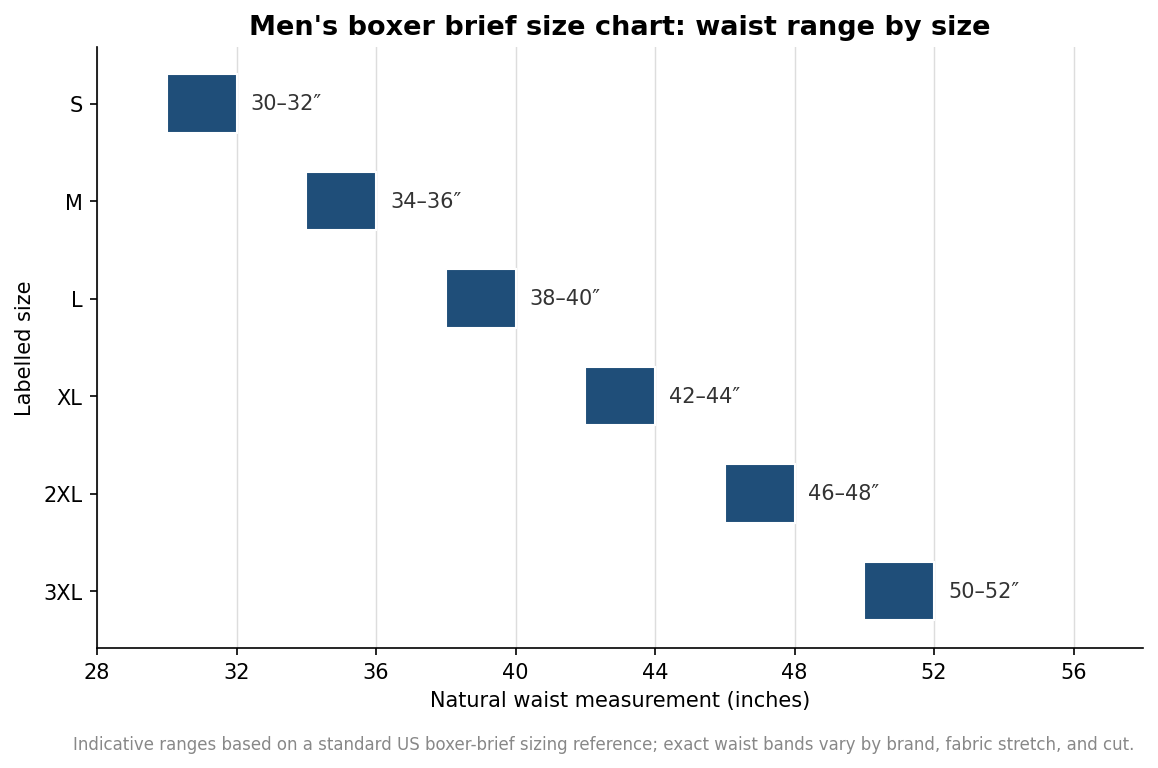
A label that reads “Large” means nothing until it is tied to a measurement. The most reliable input for underwear is the natural waist measurement in inches, taken around the narrowest part of the torso above the hip bone. On a common US boxer-brief scale, Small covers roughly a 30 to 32 inch waist, Medium 34 to 36, Large 38 to 40, Extra Large 42 to 44, 2XL 46 to 48, and 3XL 50 to 52. Those bands are indicative rather than universal: fabric with more elastane stretches across a wider range, while a trim European cut can run a full size small.
Ask your supplier for their own graded chart before you commit. Two factories both selling a “Medium” boxer brief can differ by two inches in the waistband relaxed measurement and an inch in rise. If you are matching a previous order, send the actual garment measurements, not the size letter, so the new run grades to the same body rather than to the new factory’s house block.
Build the size run from a bell curve
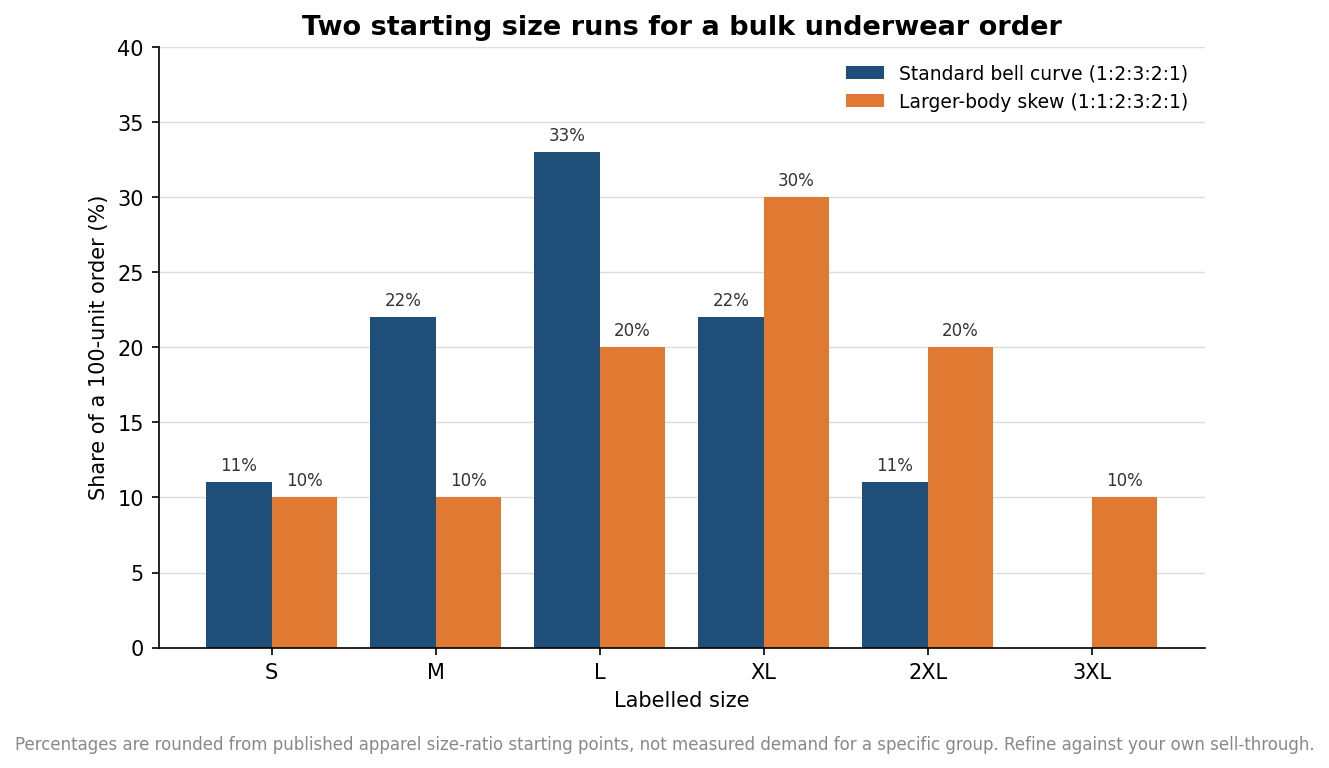
When you do not yet have individual measurements, a size run is an educated distribution rather than a guess. The apparel industry’s default starting point is a bell curve weighted toward the middle: a ratio of one Small to two Medium to three Large to two Extra Large to one 2XL. Across a 100-unit order that works out to roughly 11 percent Small, 22 percent Medium, 34 percent Large, 22 percent Extra Large, and 11 percent 2XL. The logic is simple. Most adult waists cluster in the middle of the range, and ordering a flat number of every size guarantees leftover smalls and a shortage of the sizes people actually need.
Treat that curve as version one, not gospel. It is a reasonable opening bid for a general adult population, and it is the wrong answer for a specific group whose bodies you can describe. The chart below contrasts the standard bell curve with a run shifted toward larger sizes, which is closer to reality for many North American adult groups.
Adjust the curve to who actually wears them
The bell curve assumes an average you rarely have. A workwear program for a warehouse crew skews larger and wider than a run destined for a running club. A hospitality order that has to cover every guest body needs a longer tail on both ends, carrying 3XL and up even though those sizes move slowly, because a guest who cannot wear anything in the box is a complaint rather than a statistic. If your group runs older, add weight to Large and Extra Large; if it runs athletic and young, the peak can sit a size lower.
Collect real measurements whenever the order is tied to named people. For a team roster, a uniform program, or a subscription box with known members, a two-line intake form asking for waist measurement and preferred fit removes the guesswork entirely. The bell curve exists precisely for the orders where you cannot do that, such as retail stock or open promotional giveaways.
Order fit samples before the full run
No chart survives contact with the actual garment. Before you lock a size run of any real quantity, order fit samples in at least Small, Large, and 2XL and put them on real bodies at those measurements. You are checking three things: whether the waistband sits where the label promises, whether the rise is high enough that the garment does not roll, and whether the leg length matches the style you specified. A boxer brief graded a full inch short in the rise will read as a size too small no matter what the waistband says.
Lead times make this step easy to skip and expensive to have skipped. Sampling typically adds one to three weeks up front, but a mis-graded bulk run is a lost production cycle of several weeks plus the cost of the wasted units. The sample round is the cheapest insurance in the whole process, and it is the one that first-time buyers most often cut to save a fortnight.
Common sizing mistakes that trigger reorders
The most frequent error is ordering by ego size rather than measured size, which pushes a whole run one size too small because people underreport their waist. The second is flattening the curve, ordering equal quantities of every size to keep the spreadsheet tidy, which reliably strands the extremes. The third is ignoring the tail: dropping 3XL and up to hit a lower minimum order quantity, then discovering that the handful of people those sizes would have covered are exactly the ones who now have nothing to wear. Each of these is cheap to avoid at the specification stage and costly to fix after the goods have shipped.
Sizing is where a custom underwear order is quietly won or lost. Anchor every size to a measurement, start from a weighted curve rather than a flat split, bend that curve toward the group you are actually dressing, and prove it with fit samples before the main run. Do that and the box gets worn instead of returned.