Fabric is the decision that quietly determines whether a run of custom underwear feels premium or disposable. Waistband art and packaging get the attention, but the hand of the knit, how it holds a print, how it survives industrial laundering, and how it drapes on a range of body types all come down to fiber choice and construction. This is a look at the four materials that account for most custom underwear orders, what separates them, and how to match one to the job.
Weight and construction come first
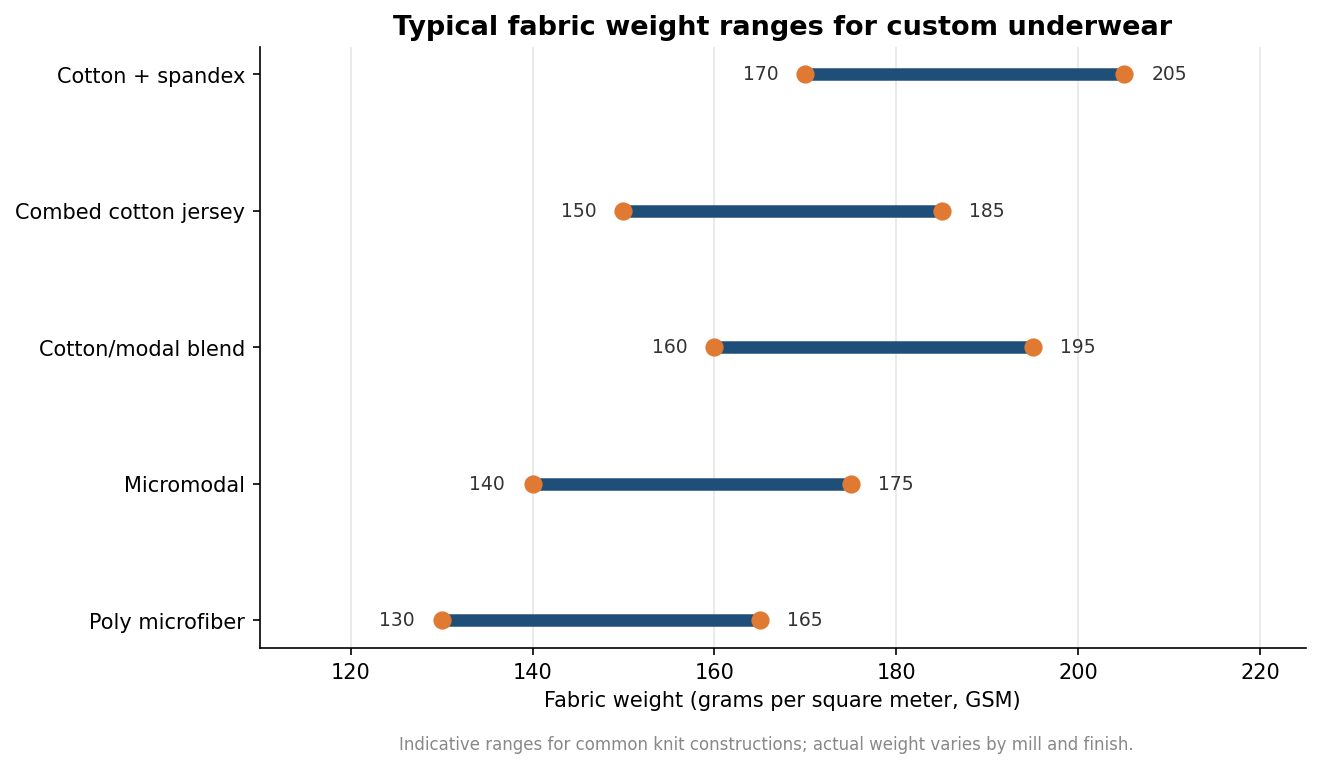
Before choosing a fiber, settle on a weight. Underwear knits are measured in grams per square meter, and most fall between roughly 130 and 205 GSM. Lighter fabrics in the 130 to 160 band feel airy and pack down small, which suits briefs, liner-style trunks, and warm-climate wear. Heavier knits from about 180 to 205 GSM give a boxer brief structure and opacity, resist showing through, and stand up better to repeated washing. The trade-off is real: a heavier garment feels more substantial in hand but runs warmer and costs more per piece in yarn.
Almost every modern underwear knit is a blend. A pure cellulose or cotton fabric has little recovery, so manufacturers add roughly 5 to 15 percent elastane, often labeled spandex or Lycra, to give the garment stretch and the ability to snap back after wear. When you specify a fabric, you are really specifying two things: the main fiber that sets the character, and the elastane percentage that sets the fit and longevity. A garment with 5 percent elastane feels relaxed; one with 12 to 15 percent hugs and holds shape through more wash cycles.
Cotton and its blends
Cotton is the default for a reason. It is breathable, absorbent, soft against skin, and it takes reactive and pigment dyes cleanly, which makes solid colors easy and consistent. Combed and ring-spun cottons remove short fibers for a smoother, stronger yarn that pills less than carded cotton. The two weaknesses to plan around are moisture and shrinkage. Cotton holds sweat rather than moving it, so it dries slowly, and untreated cotton can shrink noticeably on the first few hot washes. Specifying combed, ring-spun, pre-shrunk cotton with a small elastane content addresses most of this, and it keeps cotton the safest choice for everyday retail and promotional programs where familiarity matters more than performance.
Modal, micromodal, and bamboo viscose
These three are cellulosic fibers, made by regenerating wood pulp or plant cellulose into a filament, and they share a distinctive silky drape that cotton cannot match. Modal and micromodal, spun from beech pulp, are prized for a smooth, cool hand, strong color retention, and better resistance to pilling and shrinkage than cotton. Micromodal uses a finer filament for an even softer feel, which is why it anchors most premium and luxury underwear lines. The cost climbs accordingly, because micromodal sits above standard cotton on yarn alone.
Bamboo viscose occupies a middle position: soft, fluid, and often marketed for temperature regulation. Two things are worth knowing before you print a label. First, most so-called bamboo fabric is chemically a viscose or rayon, and United States labeling rules require it to be identified that way, typically as “rayon made from bamboo” or “viscose from bamboo,” rather than simply “bamboo.” Second, unqualified antibacterial or eco claims on these fabrics have drawn regulatory scrutiny, so it is safer to describe the feel and drape than to promise health benefits you cannot substantiate.
Polyester microfiber and the printing question
Polyester microfiber behaves the opposite way to cotton. It is hydrophobic, so instead of absorbing moisture it wicks it to the surface to evaporate, which is why performance and athletic underwear lean on it. It is also strong, quick to dry, and dimensionally stable, meaning it barely shrinks. The single most important thing polyester unlocks is dye sublimation. All-over, edge-to-edge custom graphics are produced by sublimating dye into a polyester substrate, a process that simply does not work on cotton or cellulosics. If your design calls for a photographic waistband, a repeating all-over pattern, or full-color panels, the base fabric essentially has to be polyester or a high-polyester blend. The trade-off buyers report is a less natural hand and, on cheaper knits, less breathability, both of which improve as you move to finer microfiber yarns.
Matching the fabric to the order
Start from the end use. For a broad retail or giveaway program where cost and familiarity lead, combed cotton with a touch of elastane is hard to beat. For a premium label where the selling point is feel, micromodal or a cotton-modal blend earns its higher yarn cost. For athletic or moisture-heavy use, or any design that needs an all-over sublimated print, polyester microfiber is the practical answer. Bamboo viscose sits between comfort and story, and it works well when you want a soft, drapey hand and are prepared to label the fiber content correctly.
Two order-level realities shape the decision as much as the fiber itself. Custom cut-and-sew production, where the garment is built to your pattern and fabric, usually carries higher minimums per colorway and a longer lead time, because fabric has to be knit, dyed, and cut to order. Printing onto ready-made blanks, by contrast, lets you order far smaller quantities, from just 12 pieces, on shorter timelines, at the cost of choosing from stock fabrics. Standard production is about 2 weeks, so ask for a quote that names your fabric and quantity. Decide the weight and the decoration method first, and the shortlist of workable fabrics usually narrows to one or two on its own.