A bulk custom underwear order looks simple on a spec sheet and punishes you in the details. The garment is small, but it is a fitted, next-to-skin knit with elastic, seams, and branding, and each of those is a place where a rushed decision turns into a pallet of product nobody wants to wear. The good news is that the expensive mistakes are predictable. Here are the five that catch buyers most often, and how to design around each before you commit a purchase order.
Skipping the fit sample to save two weeks
The most expensive shortcut is approving a bulk run from a tech pack alone. Fit, fabric hand, seam comfort, and how the leg openings and waistband behave in motion can only be judged on a physical sample worn on a real body, and none of it reads reliably from a drawing or a photo. Sampling adds a little time and a little cost up front, and that is trivial next to reprinting a full run because the leg elastic bit in or the rise sat wrong. Build the sampling round into the calendar from the start rather than treating it as optional, and wear-test the approved sample through a wash cycle before you sign off.
Ordering an even size split instead of a real size run
Buyers who are new to apparel often divide an order evenly across sizes, which quietly guarantees leftover stock at the extremes and stockouts in the middle. Demand is not evenly distributed; it clusters around medium and large for most adult audiences. A size run weights the buy toward where the demand actually sits, and getting it roughly right is worth more than any single design decision because it determines how much of the run you can actually sell. Start from your own sell-through data if you have it, or from your audience if you do not, and treat an even split as the one option you know is wrong.
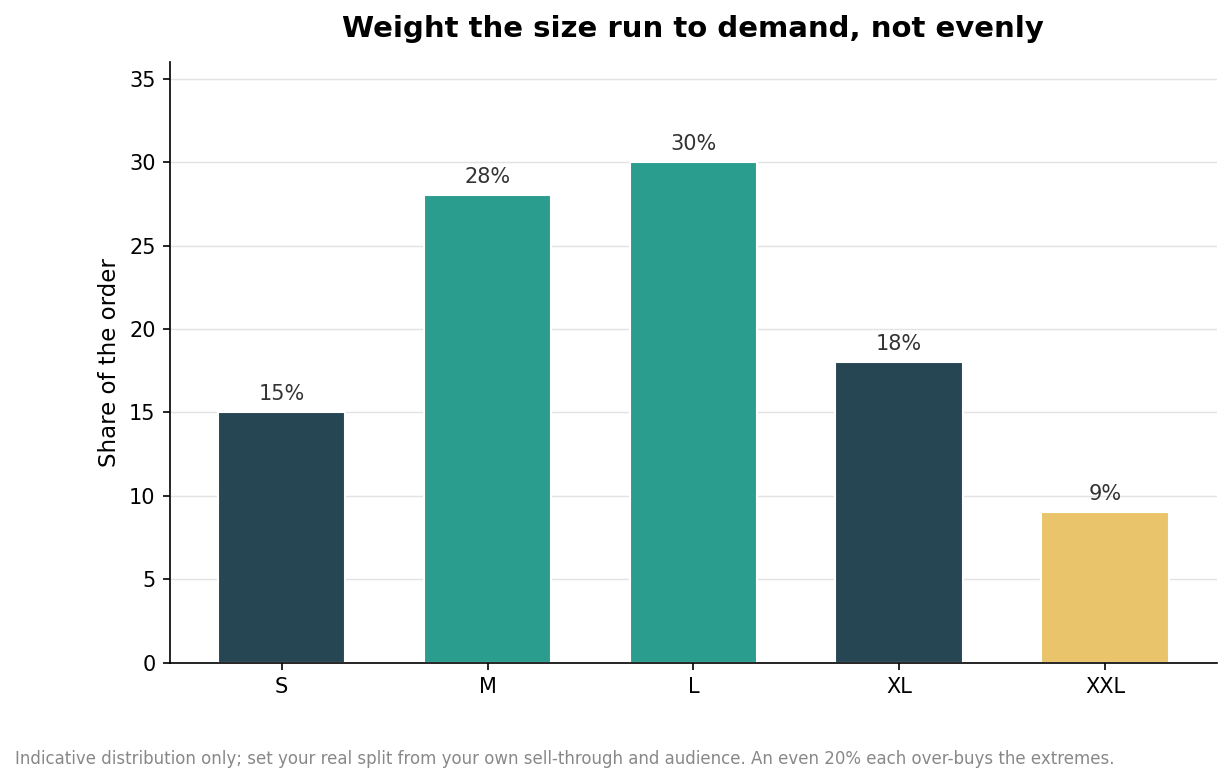
If you have no history to work from, a reasonable first approximation for a general adult audience concentrates the middle sizes and tapers the ends, then adjusts for who actually buys from you. A performance or athletic audience may skew larger; a fashion-forward or younger audience may skew smaller. The point is to make a deliberate call and refine it on the next run from what sold, rather than defaulting to equal quantities because it is the easiest number to type into a spreadsheet.
Underestimating decoration minimums, especially the waistband
Underwear has more than one minimum hiding in it. There is a fabric minimum, a minimum per color, and a separate decoration minimum for branding, and the last one surprises people most. A custom jacquard-woven waistband, where your logo is knitted into the elastic, requires its own loom setup and carries its own minimum quantity and tooling cost, which is why a small first run often cannot justify it. A printed elastic waistband achieves a similar look for far less setup and is usually the right call at low volume. Ask for every minimum in writing, fabric, color, and decoration, before you fall in love with a woven waistband your order size cannot support. Baseline order minimums vary from supplier to supplier, so confirm the number rather than assuming. Get Custom Underwear starts at just 12 pieces on printed blanks.
Specifying branding the fabric cannot take
Decoration method and fabric are a matched pair, and mismatching them is a classic reprint. Sublimation, which produces vivid all-over color, bonds dye to polyester and does not work on cotton, so a full-color print on a combed-cotton brief is simply not possible by that route. Screen printing sits on the surface and suits a placed logo on a hip or thigh but can feel stiff over a large area on a stretch knit. Tagless heat-transfer labels replace the itchy sewn tag but need the right base fabric and a durable transfer to survive washing. Decide the fabric and the branding together, and confirm your chosen method is rated for that exact material and for repeated laundering.
Fabric choice itself carries second-order effects that feed back into every other decision. Combed cotton is breathable and familiar but shrinks and takes color differently than synthetics; modal and micromodal feel silkier and resist shrinkage but cost more; bamboo blends market well on sustainability; and microfiber or nylon blends stretch and dry fast but only accept certain decoration methods. A small proportion of elastane, commonly in the single-digit percentages, gives the stretch that makes a fitted brief comfortable. None of these is the right answer in the abstract, but each one quietly constrains your branding, your shrinkage risk, and your price, so pick it early and let the rest of the spec follow.
Ignoring shrinkage, colorfastness, and regional sizing
The last cluster of mistakes shows up after the first wash and after the first international order. Knit fabrics shrink, and cotton shrinks more than synthetics, so a sample that fits perfectly can tighten a size after laundering unless the fabric was pre-shrunk and you tested it; ask for a wash test and build any shrinkage into the pattern. Colorfastness matters for anything dyed deep or printed, because dye that crocks or bleeds in the wash generates returns. And sizing is not universal: a medium on a United States chart is not the same as a European or United Kingdom medium, so publish the actual body measurements in centimeters alongside the letter sizes and confirm the factory is grading to your chart, not its own house standard. These are cheap to check up front and costly to discover in a customer’s laundry.
None of these require deep manufacturing expertise, only the discipline to slow down at five specific points, sampling, the size run, the minimums, the branding-to-fabric match, and the wash behavior. Handle those and a bulk underwear order is one of the more forgiving custom apparel products. Skip them and it is one of the least.