Category: Uncategorized

  • How to Specify Sizes for a Bulk Custom Underwear Order

    How to Specify Sizes for a Bulk Custom Underwear Order

    Style and fabric decide how a custom underwear order feels. Sizing decides whether it gets worn at all. A run that skews too small leaves half the box unopened, and a run that ignores who is actually receiving it turns into a reorder within a month. This walkthrough covers how to translate a headcount into a size breakdown you can hand to a manufacturer with confidence.

    Start with the size chart, not the size name

    A label that reads “Large” means nothing until it is tied to a measurement. The most reliable input for underwear is the natural waist measurement in inches, taken around the narrowest part of the torso above the hip bone. On a common US boxer-brief scale, Small covers roughly a 30 to 32 inch waist, Medium 34 to 36, Large 38 to 40, Extra Large 42 to 44, 2XL 46 to 48, and 3XL 50 to 52. Those bands are indicative rather than universal: fabric with more elastane stretches across a wider range, while a trim European cut can run a full size small.

    Ask your supplier for their own graded chart before you commit. Two factories both selling a “Medium” boxer brief can differ by two inches in the waistband relaxed measurement and an inch in rise. If you are matching a previous order, send the actual garment measurements, not the size letter, so the new run grades to the same body rather than to the new factory’s house block.
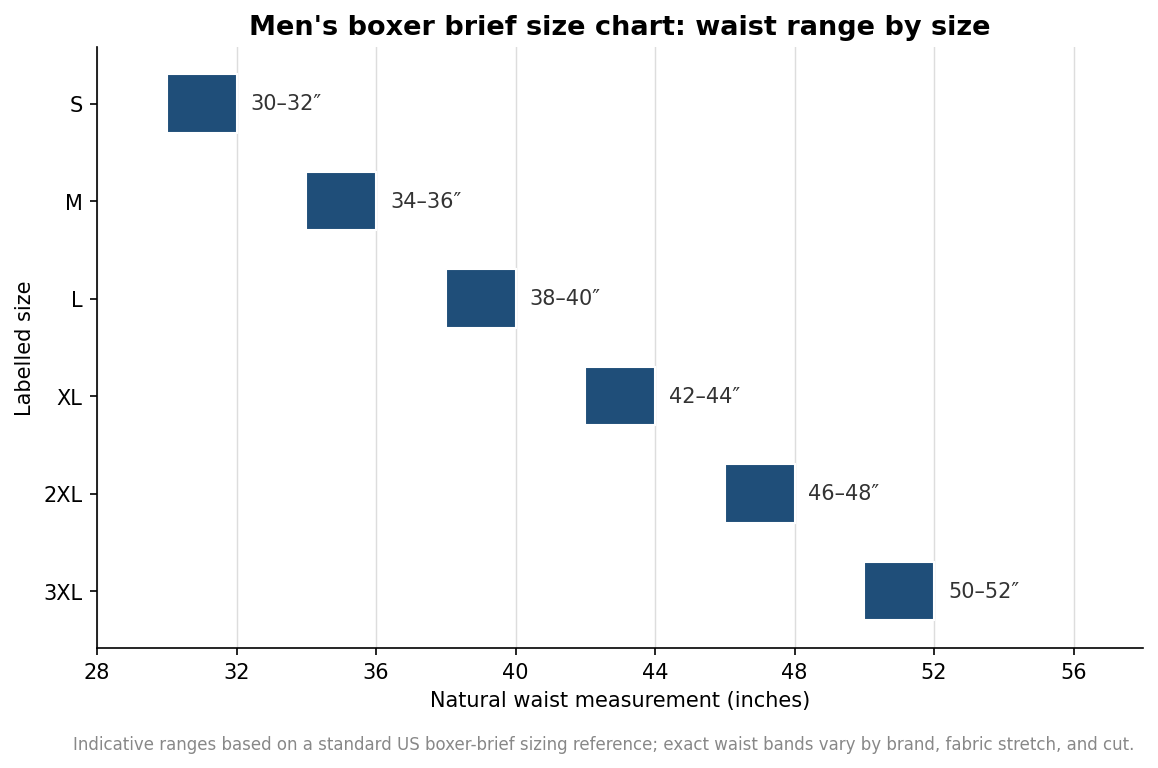
    Horizontal bar chart of men's boxer brief waist ranges from Small (30-32 inches) to 3XL (50-52 inches)
    Labeled sizes map to waist bands roughly four inches apart, but exact ranges vary by brand and cut.

    Build the size run from a bell curve

    When you do not yet have individual measurements, a size run is an educated distribution rather than a guess. The apparel industry’s default starting point is a bell curve weighted toward the middle: a ratio of one Small to two Medium to three Large to two Extra Large to one 2XL. Across a 100-unit order that works out to roughly 11 percent Small, 22 percent Medium, 34 percent Large, 22 percent Extra Large, and 11 percent 2XL. The logic is simple. Most adult waists cluster in the middle of the range, and ordering a flat number of every size guarantees leftover smalls and a shortage of the sizes people actually need.

    Treat that curve as version one, not gospel. It is a reasonable opening bid for a general adult population, and it is the wrong answer for a specific group whose bodies you can describe. The chart below contrasts the standard bell curve with a run shifted toward larger sizes, which is closer to reality for many North American adult groups.
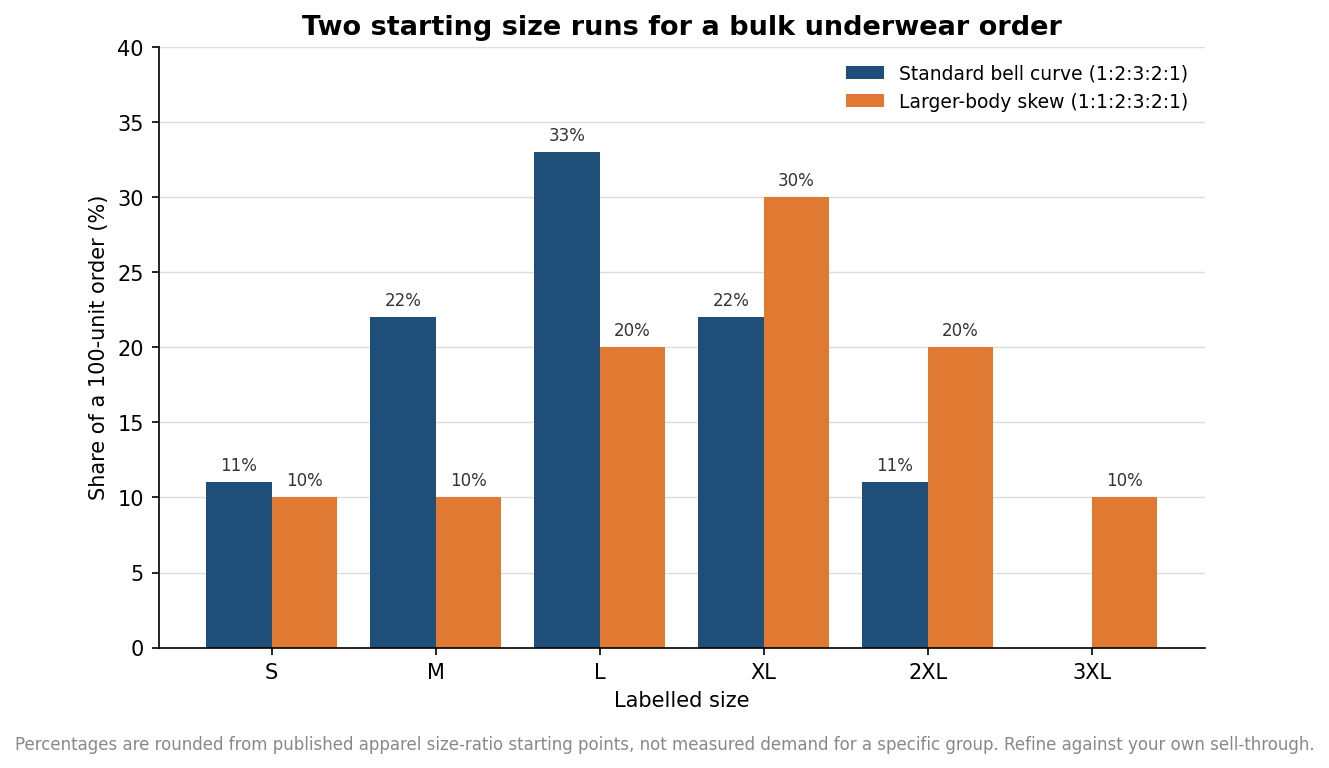
    Grouped bar chart comparing a standard bell-curve size run with a larger-body-skewed size run across sizes S to 3XL
    A standard bell curve versus a run shifted toward larger sizes for a 100-unit order.

    Adjust the curve to who actually wears them

    The bell curve assumes an average you rarely have. A workwear program for a warehouse crew skews larger and wider than a run destined for a running club. A hospitality order that has to cover every guest body needs a longer tail on both ends, carrying 3XL and up even though those sizes move slowly, because a guest who cannot wear anything in the box is a complaint rather than a statistic. If your group runs older, add weight to Large and Extra Large; if it runs athletic and young, the peak can sit a size lower.

    Collect real measurements whenever the order is tied to named people. For a team roster, a uniform program, or a subscription box with known members, a two-line intake form asking for waist measurement and preferred fit removes the guesswork entirely. The bell curve exists precisely for the orders where you cannot do that, such as retail stock or open promotional giveaways.

    Order fit samples before the full run

    No chart survives contact with the actual garment. Before you lock a size run of any real quantity, order fit samples in at least Small, Large, and 2XL and put them on real bodies at those measurements. You are checking three things: whether the waistband sits where the label promises, whether the rise is high enough that the garment does not roll, and whether the leg length matches the style you specified. A boxer brief graded a full inch short in the rise will read as a size too small no matter what the waistband says.

    Lead times make this step easy to skip and expensive to have skipped. Sampling typically adds one to three weeks up front, but a mis-graded bulk run is a lost production cycle of several weeks plus the cost of the wasted units. The sample round is the cheapest insurance in the whole process, and it is the one that first-time buyers most often cut to save a fortnight.

    Common sizing mistakes that trigger reorders

    The most frequent error is ordering by ego size rather than measured size, which pushes a whole run one size too small because people underreport their waist. The second is flattening the curve, ordering equal quantities of every size to keep the spreadsheet tidy, which reliably strands the extremes. The third is ignoring the tail: dropping 3XL and up to hit a lower minimum order quantity, then discovering that the handful of people those sizes would have covered are exactly the ones who now have nothing to wear. Each of these is cheap to avoid at the specification stage and costly to fix after the goods have shipped.

    Sizing is where a custom underwear order is quietly won or lost. Anchor every size to a measurement, start from a weighted curve rather than a flat split, bend that curve toward the group you are actually dressing, and prove it with fit samples before the main run. Do that and the box gets worn instead of returned.
  • Where Bulk Custom Underwear Orders Go Wrong: Five Mistakes to Avoid

    Where Bulk Custom Underwear Orders Go Wrong: Five Mistakes to Avoid

    A bulk custom underwear order looks simple on a spec sheet and punishes you in the details. The garment is small, but it is a fitted, next-to-skin knit with elastic, seams, and branding, and each of those is a place where a rushed decision turns into a pallet of product nobody wants to wear. The good news is that the expensive mistakes are predictable. Here are the five that catch buyers most often, and how to design around each before you commit a purchase order.

    Skipping the fit sample to save two weeks

    The most expensive shortcut is approving a bulk run from a tech pack alone. Fit, fabric hand, seam comfort, and how the leg openings and waistband behave in motion can only be judged on a physical sample worn on a real body, and none of it reads reliably from a drawing or a photo. Sampling adds a little time and a little cost up front, and that is trivial next to reprinting a full run because the leg elastic bit in or the rise sat wrong. Build the sampling round into the calendar from the start rather than treating it as optional, and wear-test the approved sample through a wash cycle before you sign off.

    Ordering an even size split instead of a real size run

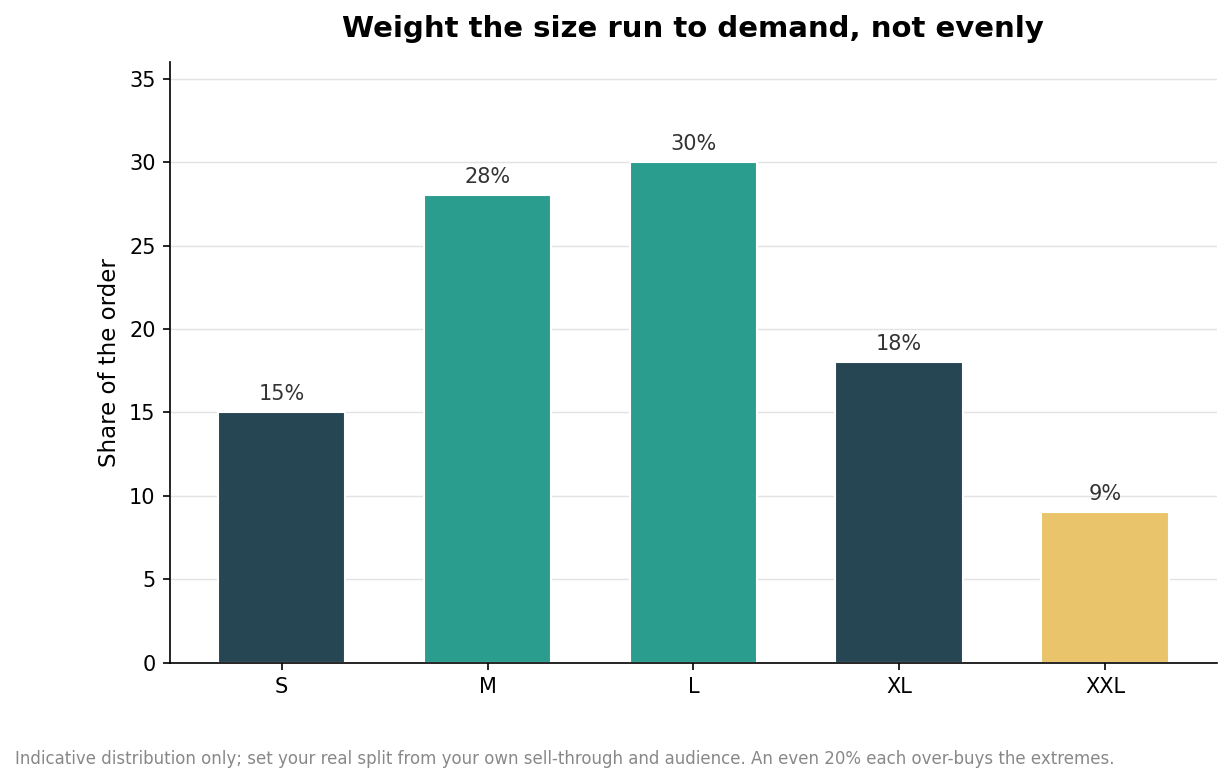
    Buyers who are new to apparel often divide an order evenly across sizes, which quietly guarantees leftover stock at the extremes and stockouts in the middle. Demand is not evenly distributed; it clusters around medium and large for most adult audiences. A size run weights the buy toward where the demand actually sits, and getting it roughly right is worth more than any single design decision because it determines how much of the run you can actually sell. Start from your own sell-through data if you have it, or from your audience if you do not, and treat an even split as the one option you know is wrong.

    Bar chart of an indicative demand-weighted size run weighted toward medium and large for a bulk underwear order
    An indicative demand-weighted size run; an even split over-buys the extremes.

    If you have no history to work from, a reasonable first approximation for a general adult audience concentrates the middle sizes and tapers the ends, then adjusts for who actually buys from you. A performance or athletic audience may skew larger; a fashion-forward or younger audience may skew smaller. The point is to make a deliberate call and refine it on the next run from what sold, rather than defaulting to equal quantities because it is the easiest number to type into a spreadsheet.

    Underestimating decoration minimums, especially the waistband

    Underwear has more than one minimum hiding in it. There is a fabric minimum, a minimum per color, and a separate decoration minimum for branding, and the last one surprises people most. A custom jacquard-woven waistband, where your logo is knitted into the elastic, requires its own loom setup and carries its own minimum quantity and tooling cost, which is why a small first run often cannot justify it. A printed elastic waistband achieves a similar look for far less setup and is usually the right call at low volume. Ask for every minimum in writing, fabric, color, and decoration, before you fall in love with a woven waistband your order size cannot support. Baseline order minimums vary from supplier to supplier, so confirm the number rather than assuming. Get Custom Underwear starts at just 12 pieces on printed blanks.

    Specifying branding the fabric cannot take

    Decoration method and fabric are a matched pair, and mismatching them is a classic reprint. Sublimation, which produces vivid all-over color, bonds dye to polyester and does not work on cotton, so a full-color print on a combed-cotton brief is simply not possible by that route. Screen printing sits on the surface and suits a placed logo on a hip or thigh but can feel stiff over a large area on a stretch knit. Tagless heat-transfer labels replace the itchy sewn tag but need the right base fabric and a durable transfer to survive washing. Decide the fabric and the branding together, and confirm your chosen method is rated for that exact material and for repeated laundering.

    Fabric choice itself carries second-order effects that feed back into every other decision. Combed cotton is breathable and familiar but shrinks and takes color differently than synthetics; modal and micromodal feel silkier and resist shrinkage but cost more; bamboo blends market well on sustainability; and microfiber or nylon blends stretch and dry fast but only accept certain decoration methods. A small proportion of elastane, commonly in the single-digit percentages, gives the stretch that makes a fitted brief comfortable. None of these is the right answer in the abstract, but each one quietly constrains your branding, your shrinkage risk, and your price, so pick it early and let the rest of the spec follow.

    Ignoring shrinkage, colorfastness, and regional sizing

    The last cluster of mistakes shows up after the first wash and after the first international order. Knit fabrics shrink, and cotton shrinks more than synthetics, so a sample that fits perfectly can tighten a size after laundering unless the fabric was pre-shrunk and you tested it; ask for a wash test and build any shrinkage into the pattern. Colorfastness matters for anything dyed deep or printed, because dye that crocks or bleeds in the wash generates returns. And sizing is not universal: a medium on a United States chart is not the same as a European or United Kingdom medium, so publish the actual body measurements in centimeters alongside the letter sizes and confirm the factory is grading to your chart, not its own house standard. These are cheap to check up front and costly to discover in a customer’s laundry.

    None of these require deep manufacturing expertise, only the discipline to slow down at five specific points, sampling, the size run, the minimums, the branding-to-fabric match, and the wash behavior. Handle those and a bulk underwear order is one of the more forgiving custom apparel products. Skip them and it is one of the least.

  • Choosing an Underwear Style for a Custom Bulk Order: Briefs, Trunks, Boxer Briefs, and Boxers

    Choosing an Underwear Style for a Custom Bulk Order: Briefs, Trunks, Boxer Briefs, and Boxers

    When you are producing custom underwear in bulk, the cut you choose does more work than any first-time buyer expects. It sets how the garment fits, how the fabric behaves in wear, how much space you have for branding, and, most of all, whether the people you are making it for will actually reach for it. The most common and most expensive mistake is picking the style you personally prefer instead of the one your audience wants. A promotional run for a gym crowd and a hospitality amenity for a hotel are not the same product, and the cut is where that difference starts.

    The five cuts and what each one is for

    Briefs have no leg and a supportive front pouch. They use the least fabric, sit compactly, and suit athletic, minimalist, and value-focused runs where coverage is not the point. Bikini or micro briefs are cut even lower and narrower, a fashion-forward style with slight coverage that appeals to a specific market rather than a general one.

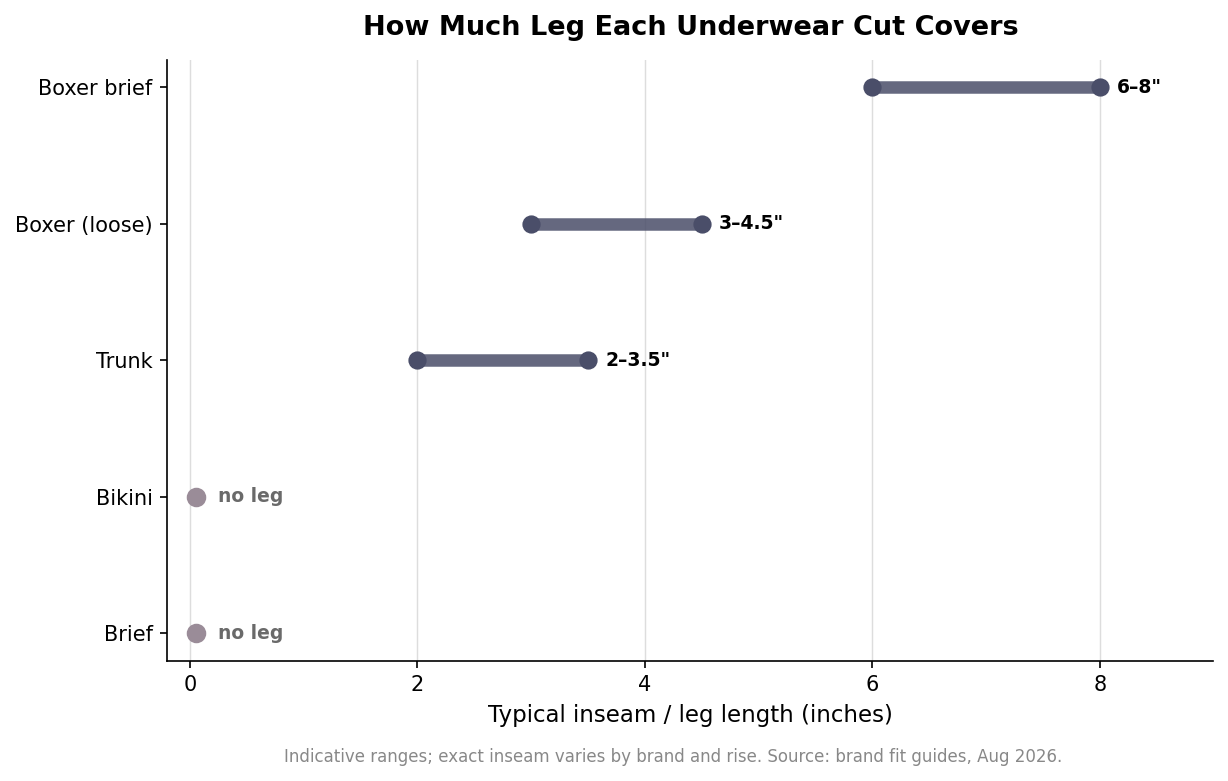
    Trunks are the short-legged, square-cut middle ground: a fitted leg with only a couple of inches of inseam, which flatters shorter frames, works well under slim trousers, and reads as modern. Boxer briefs are the mainstream default, a fitted cut with a longer six-to-eight-inch leg that prevents ride-up, supports movement, and is what most people picture when they hear custom underwear. Boxers are the loose, woven, full-coverage option built for lounging and light activity rather than support, and they behave more like a soft short than a fitted base layer.

    Range chart showing typical inseam length by underwear cut, from no-leg briefs to six-to-eight-inch boxer briefs
    Leg length rises from briefs and bikinis through trunks to boxer briefs and loose boxers.

    Match the cut to the wearer and the occasion

    Once you see the cuts side by side, the selection almost makes itself if you start from the audience rather than the aesthetic. For an athletic or activewear run, boxer briefs win because the longer fitted leg controls chafe and stays put during movement; trunks are a reasonable warm-weather alternative. For an everyday retail line aimed at a broad adult audience, boxer briefs again carry the most volume, with trunks as the style-conscious second option. For a promotional giveaway where cost per unit and universal appeal matter more than fit precision, briefs or loose boxers stretch the budget and offend no one. And for a hospitality or amenity program, loose boxers or simple briefs in a soft, easy-care fabric fit the disposable-yet-comfortable brief that hotels actually want. Choosing by occasion, not by what looks best on a model, is what keeps a bulk order from sitting in a warehouse.

    How the cut changes your branding

    The cut also decides where and how you can print, which is easy to overlook until the proofs come back. Fitted styles, trunks and boxer briefs, give you a clean, flat leg band and a smooth panel that show a logo or an all-over pattern crisply, and they pair naturally with a branded elastic waistband. Loose boxers offer more total surface area but a rumpled one, so detailed artwork can distort in the drape and they lean toward simple prints or a strong waistband instead. The decoration method follows the fabric as much as the cut: dye sublimation, which is how vivid all-over designs are achieved, needs a polyester or microfiber base and will not take on cotton, while screen printing or heat transfer handles logos on cotton blends, and a woven or jacquard waistband carries a brand name durably regardless of the cut. Decide the branding and the cut together, not in sequence.

    Do not forget the size run

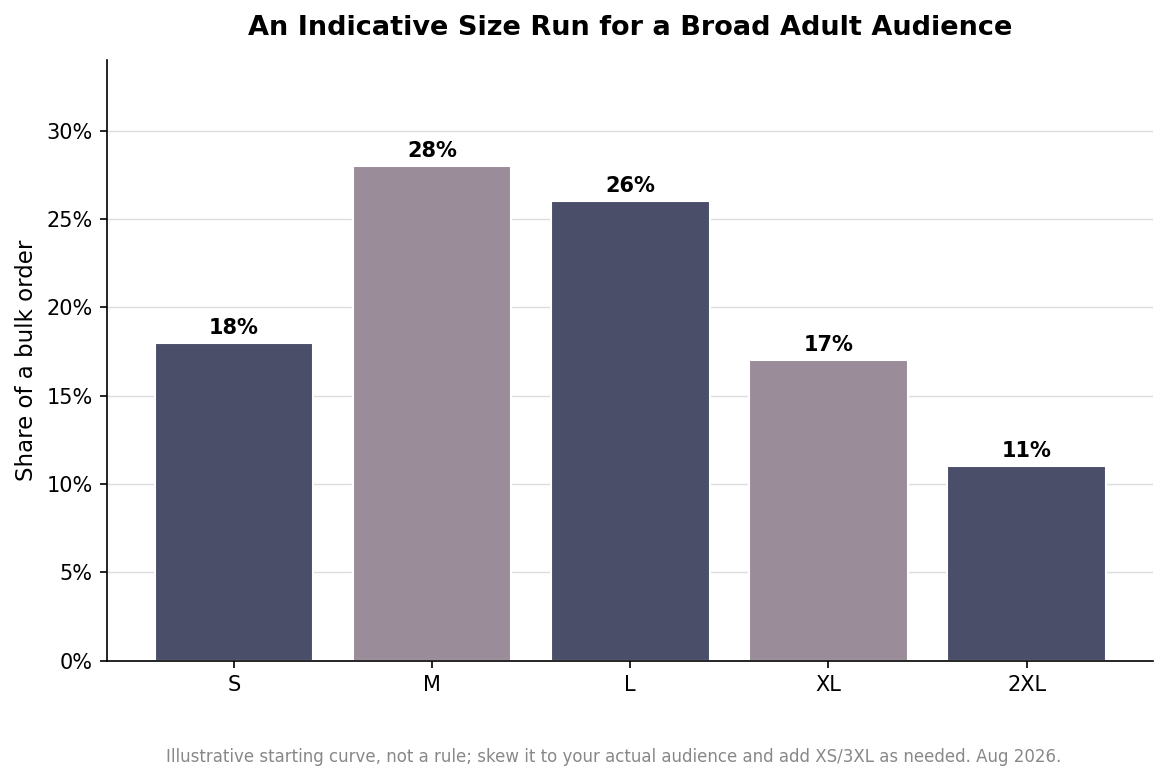
    Choosing a cut is only half of a bulk decision; the other half is how many of each size you order. A run that is heavy on smalls or short on the middle sizes leaves you with unsellable stock and stockouts at the same time. Most adult programs cluster demand in medium and large, taper toward the ends, and cover roughly small through double-extra-large as a baseline, with extra-small and triple-extra-large added when the audience is broad or specific. Treat any generic size curve as a starting point and skew it toward your real customers: a young athletic audience runs smaller, a general retail audience runs larger, and a corporate order should be sized off an actual headcount whenever you can get one.

    Bar chart of an indicative size-run distribution across S, M, L, XL, and 2XL for a bulk underwear order
    An indicative size curve; skew it toward your actual audience rather than treating it as a rule.

    A simple way to decide

    If you want a shortcut, work through three questions in order. First, who wears it and when, which points you to a cut: fitted and long for activity, short and fitted for style, loose for lounging, minimal for budget. Second, what is the fabric and the print, because an all-over sublimated design forces a polyester base while a printed logo is happy on cotton, and the two are not interchangeable. Third, what is the size spread of the people receiving it, which sets your order quantities before you ever confirm a color. Answer those three and the specification writes itself. Get them in the wrong order, lead with the look, and you end up with a beautiful product that the wrong people were sized for. The cut is not a detail at the end of the process; it is the decision the rest of the order hangs on.

  • Choosing Fabric for Custom Underwear: Cotton, Modal, Bamboo, and Microfiber

    Choosing Fabric for Custom Underwear: Cotton, Modal, Bamboo, and Microfiber

    Fabric is the decision that quietly determines whether a run of custom underwear feels premium or disposable. Waistband art and packaging get the attention, but the hand of the knit, how it holds a print, how it survives industrial laundering, and how it drapes on a range of body types all come down to fiber choice and construction. This is a look at the four materials that account for most custom underwear orders, what separates them, and how to match one to the job.

    Weight and construction come first

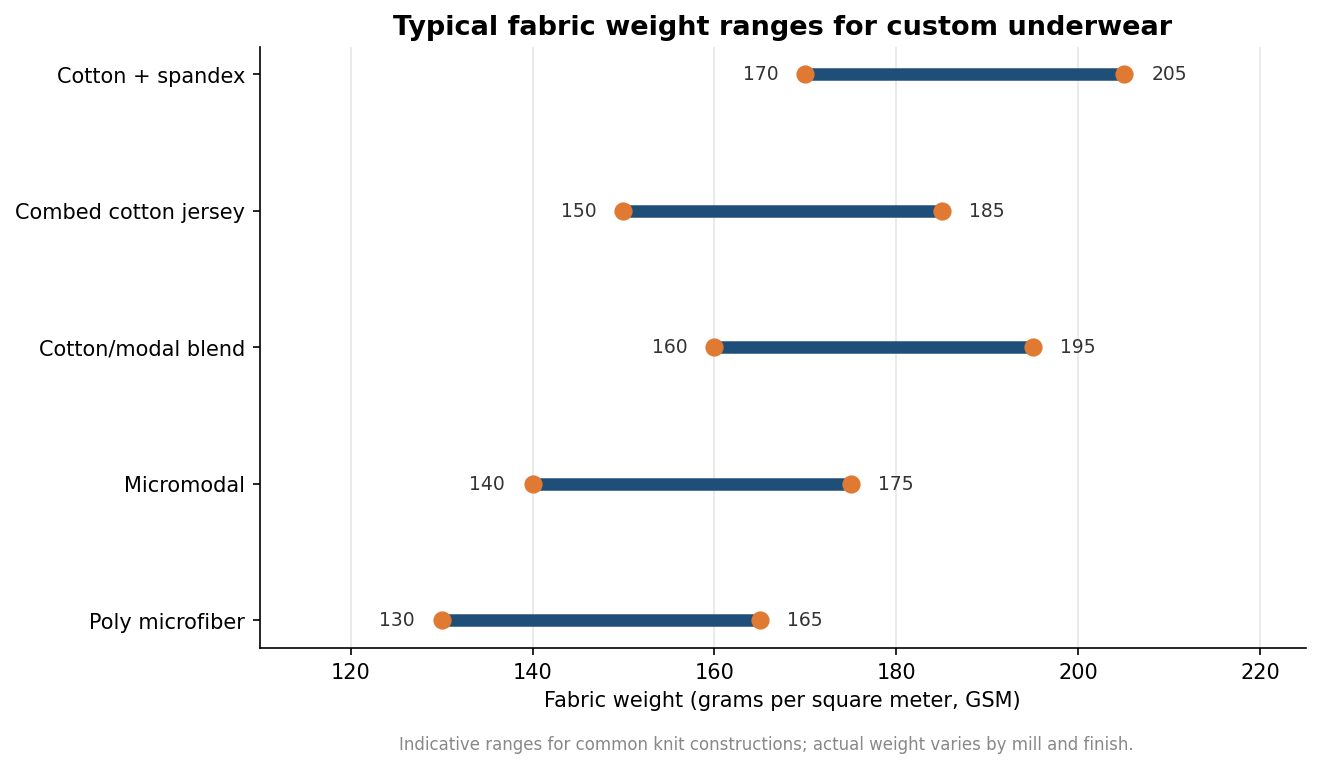
    Before choosing a fiber, settle on a weight. Underwear knits are measured in grams per square meter, and most fall between roughly 130 and 205 GSM. Lighter fabrics in the 130 to 160 band feel airy and pack down small, which suits briefs, liner-style trunks, and warm-climate wear. Heavier knits from about 180 to 205 GSM give a boxer brief structure and opacity, resist showing through, and stand up better to repeated washing. The trade-off is real: a heavier garment feels more substantial in hand but runs warmer and costs more per piece in yarn.

    Almost every modern underwear knit is a blend. A pure cellulose or cotton fabric has little recovery, so manufacturers add roughly 5 to 15 percent elastane, often labeled spandex or Lycra, to give the garment stretch and the ability to snap back after wear. When you specify a fabric, you are really specifying two things: the main fiber that sets the character, and the elastane percentage that sets the fit and longevity. A garment with 5 percent elastane feels relaxed; one with 12 to 15 percent hugs and holds shape through more wash cycles.

    Range chart of typical fabric weight in GSM for five common custom underwear knit constructions
    Typical fabric weight bands for common underwear knits, in grams per square meter.

    Cotton and its blends

    Cotton is the default for a reason. It is breathable, absorbent, soft against skin, and it takes reactive and pigment dyes cleanly, which makes solid colors easy and consistent. Combed and ring-spun cottons remove short fibers for a smoother, stronger yarn that pills less than carded cotton. The two weaknesses to plan around are moisture and shrinkage. Cotton holds sweat rather than moving it, so it dries slowly, and untreated cotton can shrink noticeably on the first few hot washes. Specifying combed, ring-spun, pre-shrunk cotton with a small elastane content addresses most of this, and it keeps cotton the safest choice for everyday retail and promotional programs where familiarity matters more than performance.

    Modal, micromodal, and bamboo viscose

    These three are cellulosic fibers, made by regenerating wood pulp or plant cellulose into a filament, and they share a distinctive silky drape that cotton cannot match. Modal and micromodal, spun from beech pulp, are prized for a smooth, cool hand, strong color retention, and better resistance to pilling and shrinkage than cotton. Micromodal uses a finer filament for an even softer feel, which is why it anchors most premium and luxury underwear lines. The cost climbs accordingly, because micromodal sits above standard cotton on yarn alone.

    Bamboo viscose occupies a middle position: soft, fluid, and often marketed for temperature regulation. Two things are worth knowing before you print a label. First, most so-called bamboo fabric is chemically a viscose or rayon, and United States labeling rules require it to be identified that way, typically as “rayon made from bamboo” or “viscose from bamboo,” rather than simply “bamboo.” Second, unqualified antibacterial or eco claims on these fabrics have drawn regulatory scrutiny, so it is safer to describe the feel and drape than to promise health benefits you cannot substantiate.

    Polyester microfiber and the printing question

    Polyester microfiber behaves the opposite way to cotton. It is hydrophobic, so instead of absorbing moisture it wicks it to the surface to evaporate, which is why performance and athletic underwear lean on it. It is also strong, quick to dry, and dimensionally stable, meaning it barely shrinks. The single most important thing polyester unlocks is dye sublimation. All-over, edge-to-edge custom graphics are produced by sublimating dye into a polyester substrate, a process that simply does not work on cotton or cellulosics. If your design calls for a photographic waistband, a repeating all-over pattern, or full-color panels, the base fabric essentially has to be polyester or a high-polyester blend. The trade-off buyers report is a less natural hand and, on cheaper knits, less breathability, both of which improve as you move to finer microfiber yarns.

    Matching the fabric to the order

    Start from the end use. For a broad retail or giveaway program where cost and familiarity lead, combed cotton with a touch of elastane is hard to beat. For a premium label where the selling point is feel, micromodal or a cotton-modal blend earns its higher yarn cost. For athletic or moisture-heavy use, or any design that needs an all-over sublimated print, polyester microfiber is the practical answer. Bamboo viscose sits between comfort and story, and it works well when you want a soft, drapey hand and are prepared to label the fiber content correctly.

    Two order-level realities shape the decision as much as the fiber itself. Custom cut-and-sew production, where the garment is built to your pattern and fabric, usually carries higher minimums per colorway and a longer lead time, because fabric has to be knit, dyed, and cut to order. Printing onto ready-made blanks, by contrast, lets you order far smaller quantities, from just 12 pieces, on shorter timelines, at the cost of choosing from stock fabrics. Standard production is about 2 weeks, so ask for a quote that names your fabric and quantity. Decide the weight and the decoration method first, and the shortlist of workable fabrics usually narrows to one or two on its own.

  • Specifying Underwear for Hotels and Hospitality

    Hospitality stock answers a different question from branded apparel. Nobody chose it, nobody kept it deliberately, and it has to be right on the first wear because there is no second one.

    Sealed, single, and obviously new

    Every piece goes out in its own sealed pack. That is not a packaging preference; it is the only way a guest can see that the item is unused, and it is what makes the whole category acceptable in the first place.

    Keep the pack itself plain and clean, with the property mark small. Loud branding on something intimate reads as a promotion rather than a courtesy.

    Fewer sizes, wider fit

    A property cannot hold a full XS to 4XL curve in every room store. The usual answer is three or four sizes cut with more stretch and a more forgiving rise, so each one covers a wider band than a retail equivalent would.

    Soft combed cotton or bamboo is the safer fabric here. It suits every guest and every climate, and it does not carry the odor that cheap polyester develops in a warm room.

    Packaging that survives the trolley

    Packs are handled far more than retail stock: loaded into carts, stacked in linen rooms, carried down corridors. A flimsy sleeve arrives creased and looks second-hand before a guest ever sees it.

    Specify a heavier sleeve or a rigid card backing, and ask for cartons split by size and labeled on the outside so housekeeping never has to open one to find out what is in it.

  • Jacquard vs Printed Waistbands

    Almost every question about branded underwear eventually becomes a question about the waistband, because that is the only part anyone sees and the only part that carries the name.

    How each one is made

    Jacquard elastic is woven on a narrow-fabric loom with the brand built into the weave as a structure of threads. There is no ink and nothing sitting on the surface, so there is nothing to crack, lift or fade. It is set up per design, which is why it carries a tooling step and a longer first lead time.

    Printed elastic takes a finished tape and prints onto it. It is fast, it reproduces fine detail and multiple colors cleanly, and it costs materially less. What it does not do is survive indefinitely: the print sits on a surface that stretches every time the garment is put on.

    What each one does to your artwork

    Jacquard resolves to a limited number of thread colors and a minimum stroke weight. Hairlines vanish, tight counters fill in, and gradients are not possible at all. A mark that works on a website often needs a bolder, simplified variant drawn specifically for the waistband. That variant is worth having anyway.

    Print will take almost anything, including photographic color, which makes it the right answer for a short seasonal run, a fashion drop or a design that changes every quarter.

    Choosing between them

    If the garment is meant to last and to be reordered in the same design, weave it. If the design is short-lived, detailed or multi-colored, print it.

    For a first order, a common approach is to print the pilot run to test the design and the size curve, then move to jacquard for the repeat once the artwork has stopped changing.

  • The Complete Buyer’s Guide to Custom Underwear

    Underwear is ordered like promotional apparel and worn like personal apparel, and the gap between those two things is where most orders go wrong.

    Four decisions carry almost all of the outcome. None of them are complicated, and all of them are easy to leave off a purchase order.

    Start with fabric, then fix the weight

    Combed cotton with a small percentage of elastane is the default for a reason: it is soft immediately, it holds shape through a wash cycle, and it prints and dyes predictably. Bamboo viscose is cooler against the skin and drapes more softly, at the cost of a longer drying time. Recycled polyamide and polyester move moisture fastest and are the only sensible choice for anything worn during exercise, but they need mesh panels to stay breathable.

    Then pin the weight. Between roughly 150 and 200 GSM is the usable band for everyday styles. Below that the fabric goes translucent under light trousers and shows every seam. Above it the garment feels heavy and sleeps hot. A quote that names a fabric but not a GSM has not actually specified anything.

    The waistband is the whole brand

    It is the only part of the garment anyone else ever sees, and it is where the two common constructions diverge sharply. Woven jacquard elastic has the name woven into the tape itself, so it cannot rub off, and it survives the life of the garment. Printed elastic is cheaper and faster, and the print cracks and lifts somewhere between the tenth and the thirtieth wash.

    Jacquard has one real constraint: fine detail disappears. A logo with hairlines, gradients or small counters has to be redrawn as a bolder single-weight mark before it is woven. Ask for that redraw as part of the proof rather than discovering it on the delivered goods.

    The gusset and the seams decide comfort

    A separate gusset panel — a diamond or oval of fabric set into the crotch — is what keeps four seams from meeting at the point of the garment that moves and stretches most. Its absence is the single most common cause of a returned sample.

    Flatlock seams sit flush instead of standing proud, which is what stops chafing on anything worn under a waistband or during exercise. Overlocked seams are quicker and cheaper and are fine on a relaxed cotton boxer; they are not fine on a performance brief.

    Order the whole size curve

    Underwear is the least forgiving garment to size badly, and a run that stops at XL quietly excludes a real share of any group. Every style we make runs XS to 4XL, and the honest way to split a bulk order is to ask people rather than to apply a standard curve.

    Build in a small overage on the middle sizes for replacements. It costs very little at the time of the order and it is expensive to add later as a second run.

    What to send when you ask for a quote

    Fabric and GSM if you know them, style and rise, waistband construction, size spread, quantity, packaging format, and vector artwork. That is enough for real pricing on the same day.

    If you do not know the fabric yet, say what the garment is for and let the answer come back with two options rather than one.